Actively manage your path to value
Driving value from investment is nothing new - KPIs, ROIs and OKRs have been around for ever. However, in client transformation projects that I’ve recently been involved in, I’ve observed a shift towards the need to identify a clearly defined ‘path to value’, structured within a benefits framework.
Ripping out legacy platforms and replacing them with new systems is not necessarily transformative in itself - if you just retain the same data, processes and capabilities around it, you’re going to limit how much value you generate from the cost of change.
Even if the underlying reason for change is functional rather than strategic - a burning platform or software being out of warranty - as part of undertaking that change you’ve created a window to drive greater value. Can you use this as an opportunity to cleanse your data, create new working processes, reduce costs and grow revenue?
What do we mean by the path to value?
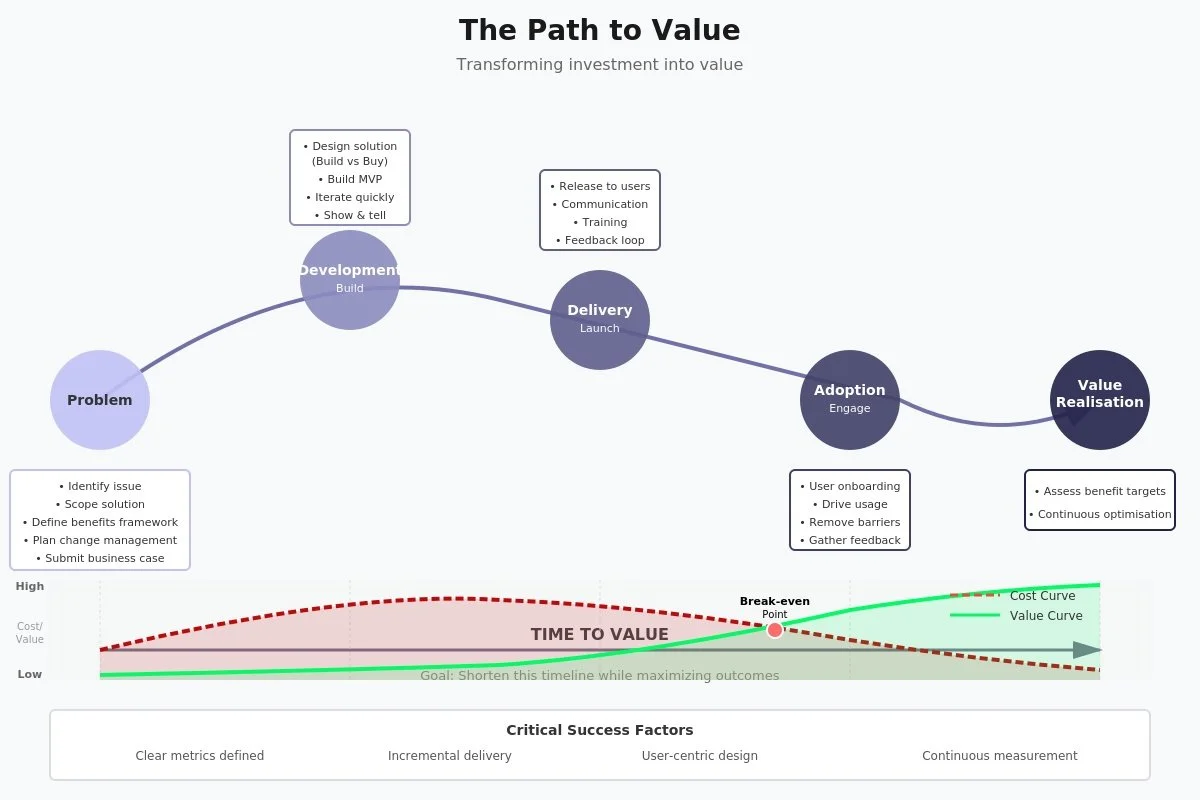
The path to value is the transformation of investment into real, tangible value. It’s less about what you’re building and more about how value actually shows up. Put simply, it’s a sequence of steps that converts an input (time, money, data, technology, behaviour) into measurable value and benefits for customers and the business.
Typically, your path to value involves identifying a problem, developing a solution, delivering a product, adoption by users and value realisation. The shorter the path, the quicker your value creation.
Key stages of the value journey
Step 1: Problem identification
Most changes start with a problem that you’re trying to solve - maybe your campaigns aren’t generating enough leads, your existing platform poses a data risk or customer conversions are trailing off.
Whatever the issue, and however big the scale of the problem, you need to identify the root cause, scope out a future-proofed solution and identify what values or benefits you’re looking to achieve. Creating a benefits framework for benchmarking where you are today in terms of costs, time to deliver, errors, user engagement etc and what you want to achieve, are vital signals underpinning your transformation.
However, value generated isn’t from new technology alone, you’ll also be saving money from retiring existing products and platforms, standing teams down, cancelling licenses and reducing data centre costs etc.
Now’s the time to start planning your change management programme. It’s people, not technology, that are the single most important factor in enabling you to successfully change and generate value.
Research from Prosci’s global change management studies show that projects with excellent change management programmes are up to 7× more likely to achieve their objectives than those with poor change management and have significantly higher adoption and ROI potential, because they deliver benefits through people-side adoption, not just technology completion.
“Projects with excellent change management are up to 7× more likely to achieve their objectives than those with poor change management and have significantly higher adoption and ROI potential”
Start by mapping out which users are going to be impacted by this new technology, is there a need to retrain or upskill them, how does your new technology impact their existing ways of working? This may be an opportunity to reset your operating model and organisational design to drive value from cost savings and process efficiencies. Useful tools such as workflow optimisation will help to bridge the gap between the As-Is and the To-Be structure.
Depending on the structure of your organisation, you may need to submit a business case requesting funding, contextualising the problem, scoping the solution, defining the implementation strategy and the benefits accrual plan.
Step 2: Development
So you know what you need to build, now you need to decide the most effective way to do it - are you going to build your solution from scratch or buy a third party off-the-shelf product? The build vs buy decision tree raises a lot of questions but ultimately you need to consider whether what you’re looking to build is so bespoke that you need to create it yourself or can a SaaS solution get to the same outcome quicker and cheaper?
Once you’ve decided and gone into build or integration, your focus needs to turn to how quickly you can release value through an MVP or MMP - the quicker you can get your product into your users’ hands, the quicker you can test and iterate.
By applying robust Agile principles, you’ll ensure that your scrum team is working towards shared goals and milestones, reprioritising if it looks like the build is going off course or deadlines are slipping - the longer it’s in production, the longer it will take for costs to reduce and value to kick in.
Use this phase as an opportunity to build excitement around your new product, invite users into early show and tell sessions, let them be your advocates.
Step 3: Delivery
Once you have a viable product for launch, now’s the time to kick off your comms plan alerting users to what’s coming, when it will launch, what impact it will have on their existing ways of working and what they need to do in preparation for it.
As part of your change management programme, you should be training users on your new system, helping them to adapt from their current ways of working to the new system. Highlight the benefits of the new system for their roles and capability growth.
Whilst you’re in delivery mode, ensure that you have a feedback loop for ongoing development (if you’ve released an MVP version), iterating based on user feedback etc.
At this stage, if you’re replacing a legacy system, it’s likely that you’ll face dual running costs until you’re sure that the new system is working as required. Therefore, full value from retirement won’t be realised until confidence in the new platform is reached. Creating a dashboard of critical factors which have to be met before switching off legacy systems is valuable in providing a structured assessment.
Step 4: Adoption
With your product live, you can now start onboarding users, growing usage and gathering feedback. Depending on the scale of the change and your resources, you may consider staggering the release of the new product to segmented groups of users.
Your change management programme should now be in full swing helping to overcome user resistance to the new system and removing barriers to adoption.
This is the most critical phase for reducing cost and releasing value. You can build the most amazing product, but if people don’t use it, find workarounds for it and revert to their old ways of doing things, then your value realisation will be stunted.
Step 5: Value Realisation
You’ve retired your old system, your new platform has been fully rolled out to all users, feedback loops are in place for continuous optimisation of people, process and technology and now’s the time to realise the full value of your investment - how have your costs reduced compared with when you stated, is your end to end delivery quicker with few mistakes, are more users engaged with your product? Refer back to your benefits scorecard to see if the transformation has achieved the desired value and if not, consider what else needs to be refined to achieve the projected outcomes.
Potential pit falls - The ‘Value Leakage’
The path to value is often porous. Value leakage occurs when a great idea loses its impact due to poor communication, low adoption rates, or shifting market conditions. To stay on the path, you must constantly monitor the "leakage" points between delivery and realisation and pivot where needed.
Summary of key principles
Time to value matters. The longer it takes to see returns, the more risk you carry and the more resources you consume. Successful teams work to compress this timeline without sacrificing quality. How can you reduce the time it takes to define the problem and deliver the solution? Can the use of AI help to speed up some of the product processes such as product discovery and prioritisation?
Value must be defined upfront. You need clarity on what success looks like—specific metrics tied to business goals. Without this, you can't tell if you're on the right path or have arrived.
Incremental delivery accelerates learning. Rather than building everything before testing value, adopt an Agile release schedule - break work into smaller releases so that you can validate assumptions earlier, pivot when needed, and start capturing value sooner.
Adoption is where many paths fail. Building something valuable means nothing if people don't use it. The path includes change management, training, communication, and sometimes incentive alignment.
Measurement closes the loop. Tracking actual outcomes against expected value tells you whether to double down, adjust course, or cut losses.
Related services