
GEO vs SEO: Assessing the impact of the changing search landscape
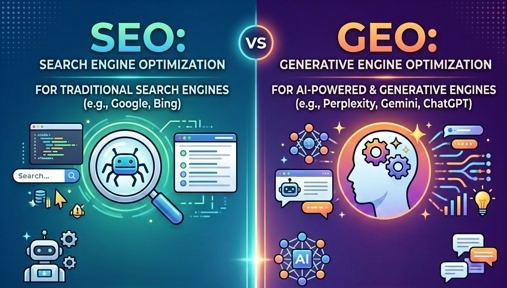
For years, websites have relied on search engine rankings to bolster their visibility and drive visitors to their site. This is particularly important for sites relying on organic traffic where users don't know the name of your website but are hunting for relevant results. Content has been crafted to position websites at the top of search results, where 'rank well, get traffic' was the underlying driver for content strategy.
In the last two years though, the search landscape has changed dramatically . Users, particularly Gen Z, are increasingly turning to chatbots to run their search queries, meaning that websites have to work harder for visibility. If your website isn't referenced within the cited source of the AI answer box, your visibility to organic traffic is zero. AI is essentially becoming your ‘primary discovery gate’.
Data published by Position Digital clearly illustrates this trend:
AI is emerging as a major search channel - search-related usage of AI (asking prompts) represents 28% of search worldwide.
Chatbot mentions drive more direct traffic - brands appearing in ChatGPT recommendations were 2.5x more likely to receive a site visit within 7 days.
ChatGPT now accounts for 20% of search-related traffic worldwide and 12% in the US. (Graphite, March 2026)
What is GEO and how does it differ from SEO?
GEO (Generative Engine Optimisation) is the process of optimising your content so that it features within the AI results of chatbots such as ChatGPT, Gemini, Perplexity and Claude etc. These chatbots need to be able to select, summarise and source your content when creating an appropriate answer to a user’s query. This contrasts with SEO (Search Engine Optimisation) which retrieves and ranks web pages using a range of indexing and ranking tools underpinned by keywords, metadata and page structure.
Chatbots have now become such an important traffic source that Google Analytics recently introduced a dedicated feed for analysing traffic from ‘popular AI assistants’ to websites under a new AI Assistant channel.
However, as there is no visible warning to say that your webpage is not being indexed, content owners should undertake GEO auditing to check whether their site is being cited by chatbots.
What can you do if you're not featuring in an AI answer?
Provide authoritative content which readers are genuinely interested in. It shouldn't just promote how good your service is but provide genuine insights for readers.
Check for visibility in the chatbots - if your competitors are appearing instead of you, consider what content they are publishing which is capturing the attention of the chatbots.
Review the structure of your site and ensure that it is optimised for AI crawlers - if AI crawlers can't crawl the content, they can't cite it.
Evaluate the information architecture on your site - does the content and layout follow a structured markup format such as all headings following the same menu boilerplate?
Assess your content distribution channels. Are you positioned in places where your viewers spend time such as YouTube, Linkedin and other social media sites?
To what extent is your content referenced on trusted third party sites and platforms - just publishing it on your website alone reduces your authority. Is it referred to in other credible forms or publications?
The prize for getting it right
Whilst fewer people click through to your site from AI search results (as they often find the answer within the chatbot), those that do are more likely to be invested in your service as the AI chatbot has called you out for being most relevant to the user’s question.
Research by Black Lab revealed that AI search traffic converts at 14.2% versus 2.8% for standard Google organic traffic. Furthermore, brands cited in AI Overviews earn 35% more organic clicks and 91% more paid clicks than brands that aren't cited — so non-cited competitors aren't just missing exposure, they're missing disproportionately higher-value exposure.
Get in touch if you’d like to find out how we can help optimise your site for this new era of AI search.
Related Services